


Remembering Valentine Fleming
Remembering Valentine Fleming – Queens Own Oxfordshire Hussars
by Trent Harron
Valentine and Evelyn
Valentine Fleming
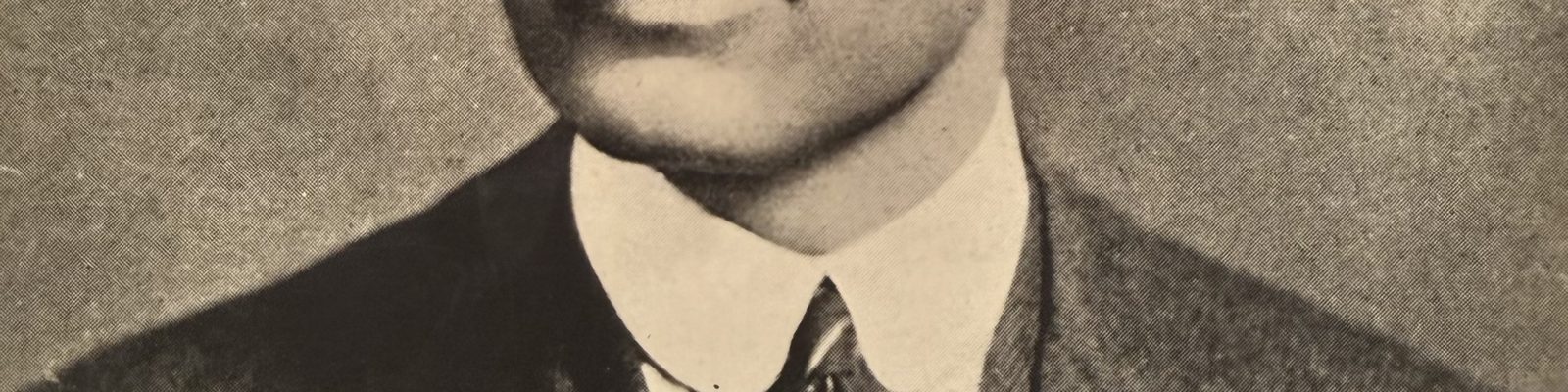
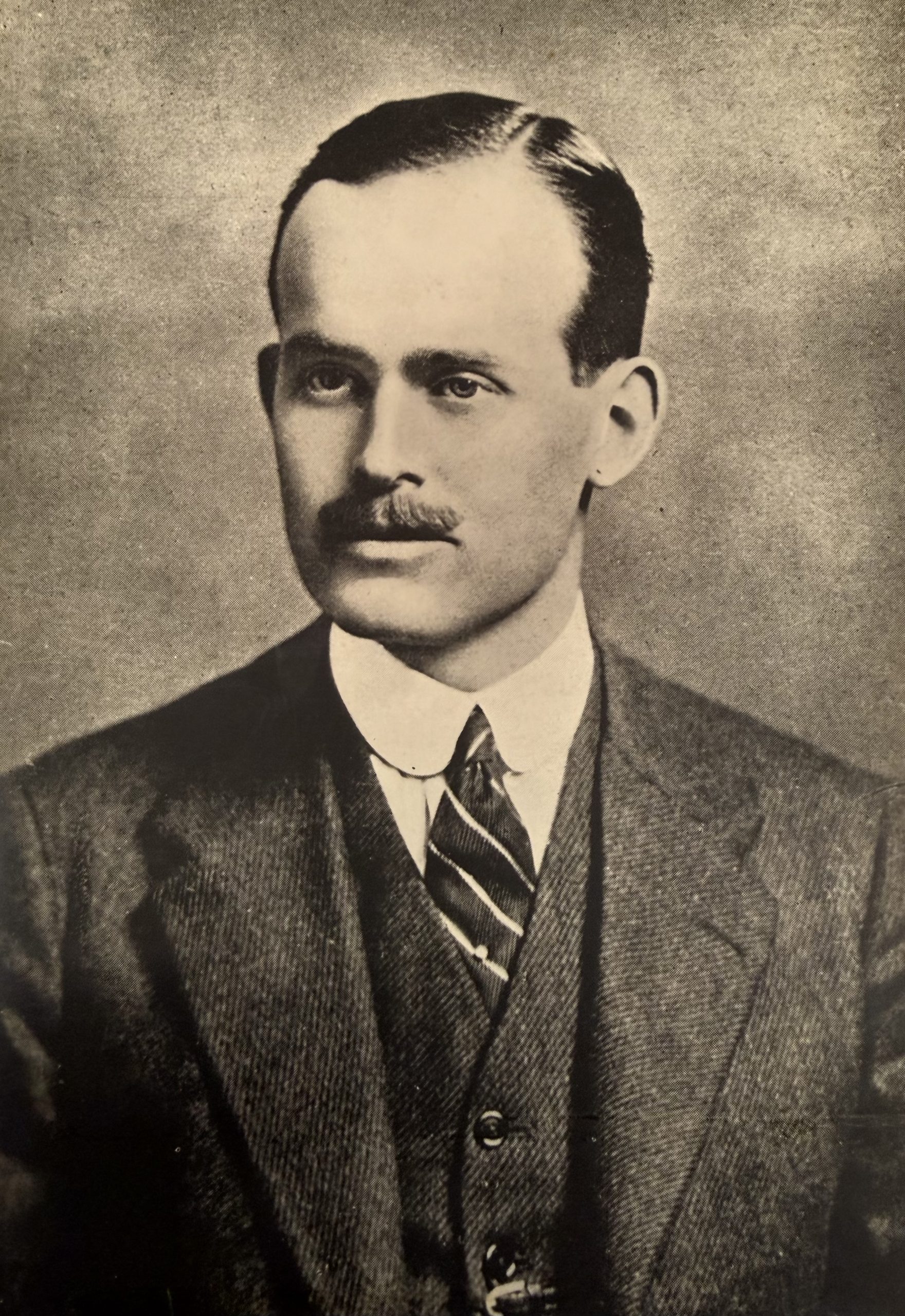
On the outbreak of war in 1914, Valentine Fleming was Member of Parliament for South Oxfordshire, serving as a Captain in ‘C’ Squadron of the Queens Own Oxfordshire Hussars (QOOH) at Henley-on-Thames. He was a husband to Evelyn, and father to four young boys, Peter, Ian, Richard, and Michael.
The Soldiers of Oxfordshire Museum holds a transcript of Evelyn’s diary covering the period from the declaration of war through to November 1914. The diary tells us of the important role that Evelyn played in supporting members of the Regiment abroad and their families back at home.
The diary also records Evelyn’s fears and anxieties in the initial stages of the war as the Regiment mobilised, departed for France, and became engaged in action. Letters exchanged with Valentine, initially a source of great confidence, gradually grow weary as the war gathers momentum, as reflected in her entry on Saturday, 14 th of November 1914, which reads;
“The first really sad letter from Val today, and I too am too sad for words, I am so afraid he may not come back, and he is too. I hear on all sides of his bravery.”
Valentine Fleming continued to serve with great distinction throughout the war until the 20th of May, 1917 when he was killed by shell fire at Gillemont Farm. He was twice Mentioned in Dispatches and posthumously received the Distinguished Service Order. Each of Valentine and Evelyn’s sons would go on to lead remarkable lives, most notably Ian, who is remembered for both his military and literary achievements, as the creator of James Bond.
Valentine and Philip
Throughout the war, Valentine Fleming served alongside his brother Philip Fleming, a fellow officer in the Queens Own Oxfordshire Hussars (QOOH). The Soldiers of Oxfordshire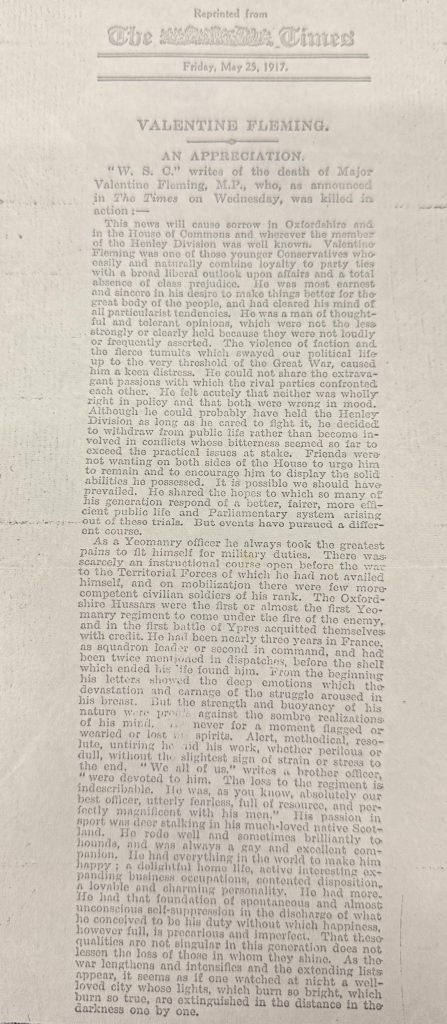 Museum retains a transcript of Philip’s diary, which provides a detailed account of the action that led to his brother’s death;
“The afternoon before they went up was spent in getting everything ready, inspecting rifles, smoke helmets, arranging about bombs and ammunition, rations and so forth. Val was always wonderfully thorough in all that sort of thing.”
He goes on to describe the circumstances leading to his brother’s death, alongside Second Lieutenant Silvertop, and Privates Buswell, Gillett, Lovejoy and White. He concludes;
“I heard about it as I was sitting at breakfast with Rawler – a note from Harold W. told me.”
Poignantly, this is where Philip’s diary ends, giving some sense of the personal devastation that the news of his brother’s death carried. Philip survived the war and returned to a successful career in banking and finance. He later established the PF Charitable Trust, which enabled the Soldiers of Oxfordshire Trust to build the museum that we occupy today.
Valentine & Churchill
Valentine Fleming was a close personal friend of Winston Churchill, having both been members of the QOOH for some time before the war, who wrote a moving appreciation that appeared in The Times on Friday the 25 th of May, 1917. Churchill reinforces Valentine’s reputation as one of the very best officers to serve with the Queens Own Oxfordshire Hussars, stating;
“Alert, methodical, resolute, untiring, he did his work, whether perilous or dull without the slightest sign of strain or stress to the end.”
Churchill shares an account from a “brother officer” who declares,
“the loss to the Regiment is indescribable. He was, as you know, absolutely our best officer, utterly fearless, full of resource and perfectly magnificent with his men.”
Churchill concludes;
“As the war lengthens and intensifies and the extending lists appear, it seems as if one watched at night a well-loved city whose lights, which burn so bright, which burn so true, are extinguished in the distance, in the darkness, one by one.”
The loss of Major Valentine Fleming D.S.O. was felt widely, not least by his immediate family. His memory is perpetuated at the Glenelg War Memorial in Scotland, the Parliamentary War Memorial in Westminster, the Town Hall in Henley, St. Batholomew’s Church in Nettlebed, and the Soldiers of Oxfordshire Museum.


