Mostly Blue – The Oxfordshire Aviation Archive (Part 1)
‘Mostly Blue’ – The Oxfordshire Aviation Archive
Balloons to Concorde and Everything in Between (Part 1)
Peter Burton and Peter Davis
Soldiers of Oxfordshire Museum is now the home of the Oxfordshire Aviation Archive which was founded in 2024 by Peter Burton and Peter Davis bringing their collections together which have since been delivered to the museum and recorded in the intervening period.

Seafire at RNAS Culham 1949.
It holds records of the history of aviation in the County – from balloons to Concorde and beyond, both military and civilian. It is the first and still the only one of its kind to be based on a single county in the United Kingdom. It provides a lasting record of all aspects of flying in every configuration, together with the inevitable consequences and impact on the lives of both permanent and transient residents in the county as defined by the Local Government Act which came into effect on 1st April,1974, bringing a substantial part of Berkshire within the county boundary, including several airfields which now come under our remit.
The OAA covers a period which began in the late 18th Century with balloons, especially those of James Sadler of Oxford who became the first Englishman to fly solo in 1884;
followed by events and activities leading up to WWI, the largely indecisive inter-war years culminating in WWII, and the extended postwar period widely known as the Cold War, continuing to the present day significance of the Civilian Sector and the fact that it is growing in all aspects of defence, with an increasing number of MoD contracts.
Oxfordshire civilian flying clubs, gliding clubs, and elementary flying training schools provided trained pilots which went into the Royal Air Force Volunteer Reserve (RAFVR), which was formed 1 st April 1936. Post WWll civilians – members of the RNVR – operated at Royal Naval Air Station Culham flying a range of aircraft before moving to RAF Benson in 1953.
All brought about major changes in the landscape, especially the usage of farmland and associated architecture, particularly in wartime. This extended to the provision of accommodation in university buildings and many college properties in both WWI and WWII, along with private country houses in the latter. In WWII manufacturing operations changed significantly, much of which extended to aircraft production; major sub-assemblies and in one case a complete aircraft. Cowley became the HQ of the Civilian Repair Organisation, with the Nuffield Organisation having plants at Abingdon, Cowley and Oxford which were major suppliers, along with the Pressed Steel Co. Ltd at Cowley, the Northern Aluminium Co. Ltd at Banbury and the De Haviland Aircraft Co. Ltd at Witney.
Numerous smaller engineering companies also played an important role, supplying parts for aircraft production both in and beyond the county boundary. Cowley was also a major centre for the repair of damaged aircraft and the recovery of materials, especially aluminium alloys, from aircraft which were damaged beyond repair, identified as No 1 Metal
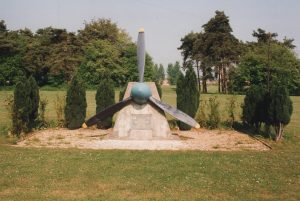
Berinsfield memorial, dedicated to 7th Photographic Reconnaissance Group of the USAAF and personnel based at RAF Mount Farm
Produce and Recovery Depot (MPRD).
During WWll the RAF were essentially involved in training, from basic flying to Operational Training Units which supplied crews for bomber command, and which occasionally also carried out sorties over enemy territory dropping propaganda leaflets and taking part in some major bombing raids. RAF Benson became the centre for Photo Reconnaissance and Brize Norton and Harwell took part in the D-Day Normandy landings, and with Broadwell aircraft towing gliders took part in the Battle of Arnhem and the Rhine Crossing.
During 1942 and 1943 the Gloucester Aircraft Company carried out flight testing of its (and the Uks) first jet aircraft and early jet fighters at RAF Edgehill and RAF Barford St John. At wars end there were 28 active airfields in the county with a further four of which would later come within the 1974 boundary. In WWll the USAAF (USAF from 18.9.47) were at RAF Chalgrove, Grove, Kingston Bagpuize and Mount Farm and during the Cold War at RAF Brize Norton and Upper Heyford.
Continued in part 2, which will look at the post-war Oxfordshire aviation in more detail, and give an overview of what can be found in the OAA.