


The Man Behind the Medals: Lt Charles Henry Wallington MC
The Man Behind the Medals
In this blog series, SOFO Museum's Research volunteers look at the stories behind some of the medal sets in the museum's collection, from those that can be seen on a visit in our dedicated Medals display to some of those that are still tucked away in the archive.
While medals will tell you a little bit about a soldier's service, it's only with further research that their full story can be revealed! SOFO's Research volunteers respond to enquiries we receive through our Research Service, helping people find out more about their relatives who served in the county regiments, and raising funds to support the museum in the process. Using a combination of the museum's records and those available elsewhere, they piece together stories like this one.
Lt Charles Henry Wallington MC
Charles Henry Wallington was born in Summertown, Oxford on 2 nd June 1897, the son of Charles and Alice Wallington. In 1911, the Wallingtons lived at 19 Stratfield Rd in Summertown, with Charles Henry working as an assistant to his father in the family grocer business. Charles was the eldest of five children, with four younger sisters.
Charles Wallington joined the Army in early 1915, initially serving as Pte 4324 in the 2/4 th Battalion, Oxfordshire & Buckinghamshire Light Infantry, a Territorial unit, part of 184 Brigade in the 61 st Division. The 2/4 th Bn was formed in Oxford in September 1914 and landed in France in May 1916.
The 2/4 th did not take part in the Battle of the Somme, being assigned to a diversionary attack on Fromelles on 19 th July 1916, followed by further service in the line near Loos. L/Cpl Wallington was reported
wounded on 6 th August 1916, however his wound could not have been too severe, since by 25 th April 1917 he had been commissioned as 2 nd Lieutenant in the Regiment.
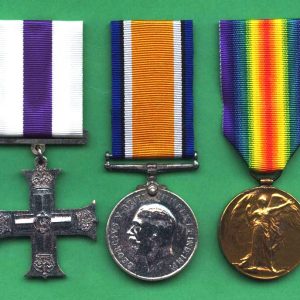
The 2/4 th played a key role at Pond Farm in the Battle of St Julien on 22nd Aug 1917, and suffered over 150 casualties. The Battalion’s attack on Hill 35 near St Julien on 10 th Sept 1917 failed miserably, with the loss of 14 officers and 260 men. Following this, in Sept 1917, the 2/4 th Bn moved to the Arras front and shortly afterwards the records note that Lt Wallington was awarded the Military Cross for “conspicuous gallantry & devotion to duty during a raid on the enemy trenches on the night of 19 th /20 th November”. He led a party which missed the gap in the cut wire, but which he led over the uncut wire into the German trenches, killed several of the enemy personally, captured a machine gun, returned to the British lines – and then led a second party out to complete the attack.

WWI medals awarded to Lt C. Wallington - Military Cross; War Medal; Victory Medal - in the museum collection
In the New Year of 1918, the 2/4 th was amongst other battalions that moved south to the front near St Quentin, regarded as a quiet sector previously held by French troops but with defences needing improvement, and where they would be spread very thinly across a wide frontline. The 2/4 th also received reinforcements from men re-assigned from the 6 th Oxf. & Bucks LI when that battalion was broken up in February. Here on 10 th March 1918, the 2/4 th moved into the line near Holnon Wood, west of St Quentin and commenced strengthening the defences.
Thus, when the last great German Offensive of the war – the Kaiserschlacht or Operation Michael – was launched on 21 st March 1918, the 2/4 th was directly in the path of the
offensive. A ferocious bombardment of High Explosive/Gas/Smoke shells began about 04.30, followed by a heavy infantry attack about 09.00. The HQ of the 2/4 th at the Enghien Redoubt held out until about 16.00, but the Battalion had taken huge casualties with some 19 officers and 562 other ranks reported recorded as killed/missing in action, with 120 later recorded as killed.
In the event, some 407 of these men became prisoners of war – including Lt Wallington, commanding B Coy, who was captured near Gricourt He spent the rest of the war in a POW
camp near Karlsruhe before being repatriated on 14 th December 1918.
After the war, Charles went back into the family business, married Cecily Stokes in 1923 and continued to live in Oxford until at least 1939.
By David Rushton, with thanks to John Sheldon


