


Object of the Month: Evacuee’s Coat (Oxfordshire’s Military Heritage in 50 Objects)
Evacuee’s Coat from our Oxfordshire’s Military Heritage in 50 Objects Exhibition
By Geraldine Howell
Object photography by Colin Morris
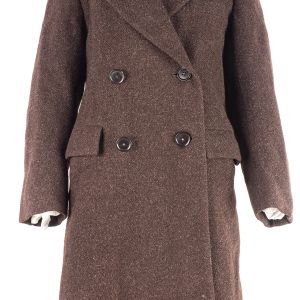
Philip Williams’ woollen, fully-lined children’s coat would certainly have satisfied the requirement for evacuees to take with them a warm winter coat as they moved from their homes to safer locations elsewhere, often in the countryside. This smart, yet also sensible and practical design, very much reflected the type of coat suggested for evacuees as also reflected in photographs of the time.
Cut from a durable, deep brown wool-weave fabric, the style has a limited A-line design with some fullness below the waist for easy movement. A half belt at the back-waist gently draws the fabric in to add shape, while the four front buttons allow for the coat to be fastened left over right or right over left. There are deep pockets with flaps for cold hands and a little extra storage, while the collar with revers provides added protection against colder weather. A small pocket on the upper left front, with a simple line of seaming at the opening, was intended, perhaps, for items such as tickets or small keepsakes. The coat shows little sign of wear and tear, given its age of approximately 83 years, with only very minor damage to the outer fabric and some small patches of staining on the lining.
The inside of the coat reveals two labels. The first, on the upper right side, and printed in white copperplate lettering on a black ground, is the makers name ‘Maenson’ – perhaps referring to the clothing company Joseph May and Sons situated in Yorkshire, a county much associated with wool production at this time. The second label sitting below the maker’s name is a white rectangle imprinted with two large C shapes and the number 41 all in black. Under this mark, below a line of black stitching, is the number 212. These marks together tell us more about how and when the coat was made.
Clothes rationing had been introduced in June 1941. In tandem with paying for a garment, coupons were now required to complete the purchase of most items of clothing. This measure was designed to limit the number of garments an individual could acquire in a year. As supplies for the civilian market became limited, in favour of necessary war production, the high street retailer would have less to sell. The government hoped to avoid home front shortages by constraining the public’s capacity to buy, thereby safeguarding fair shares for all.

Civilian clothing prices had, however, continued to rise after rationing as manufacturers and customers made and bought, respectively, higher priced items aiming for maximum coupon value. But not everyone could afford these more expensive, better-quality items. This threatened the fair shares principle. The government, therefore, stepped in again with new regulations designed to control both the type and quality of fabrics used for clothing and the prices at which they could be sold. Clothes had to reach a fit-for-purpose standard and be affordable across the price spectrum.
All cloths falling under the new regulations would now have their construction specified and recorded via a three or four figure code number. Each fabric was also matched with the types of garments for which it was best suited. The very poorest fabrics with little or no durability, offering the cheapest and lowest quality of clothing, would now be largely eliminated. When precious coupons were surrendered on the high street, buyers needed the assurance that their purchases represented good value for money and were worth the coupon outlay.
The fabrics produced under this system were known as Utility. The first of these appeared in September 1941 alongside the Utility mark – CC41. By November it was compulsory to add the CC41 mark to all Utility fabrics and garments. The first Utility clothes, which began to appear early in 1942, were simply clothes made from Utility fabrics. By June of 1942 the trade magazine The Drapers’ Record stated that fabric specification numbers were to be added to Utility cloth[1]. These numbers eventually appeared on Utility garments as well in August 1943.[2]

The Utility label on Philip Williams’ coat validates that it was a Utility coat made with Utility cloth. The number 212 refers to the three-figure code for a Utility wool tweed that was to be sold at a specific price. Interestingly, in a Board of Trade document from April 1942, the wool fabric 212 listed in the schedule and described as ‘woollen tweed and other woollen cloth’ had the highest price per yard ascribed to it of all the three figure wool cloths recorded at that time. The nearest to it – at a little over 2 shillings cheaper – was a wool gabardine numbered 223. This suggests that the coat was of a higher quality weave and could, therefore, be sold by retailers at a higher, yet still controlled, price. Philip’s winter coat would appear to represent one of the higher-quality Utility lines available, a view certainly born out by the careful attention to presentation and finish across the garment as a whole.
If Philip’s coat was purchased at any time during the first two years of rationing 11 coupons would have been needed. This was the number for a coat of 29 inches or longer. During 1942 another set of restrictions known as the Austerity regulations were introduced. This limited elements of style and decoration on all commercially-manufactured clothing streamlining design and eliminating unnecessary use of fabric and trimming. The more traditional, uncomplicated design of Philip’s coat might suggest it was little affected by the austerity requirements although its manufacture would have been regulated by them.
As Philip’s coat has both the CC41 number and a cloth specification number, it is likely the coat was produced at some point later in 1943 or after.
Sources
[1] The Drapers’ Record, June 20 1942, p. 24 SR&O 1012. See also E. L. Hargreaves and M. M Gowing. Civil Industry and Trade, (HMSO, 1952) p. 433
[2] Hargreaves and M. M Gowing. Civil Industry and Trade, p. 433


